
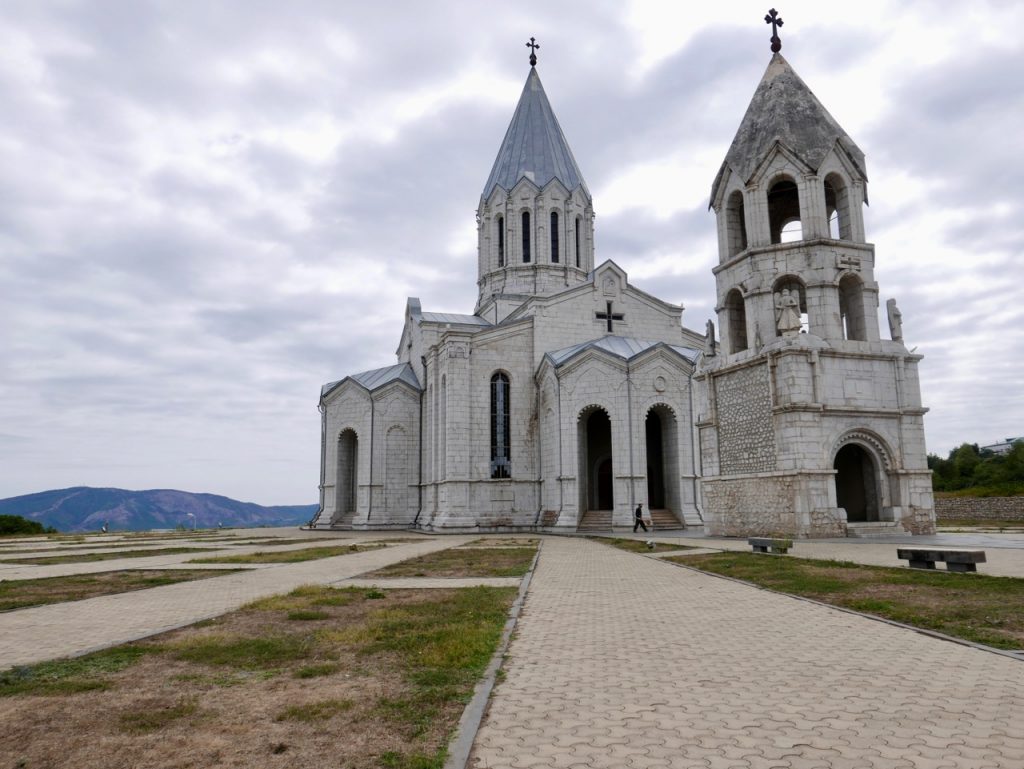
WCC: Prayers for Armenia at Geneva’s St Pierre Cathedral draws feelings of unity
The prayers on 21 January were followed by a conference to launch a book, Freedom of Religion and Preservation of Armenian Religious, Cultural, and Historical Heritage in Artsakh/Nagorno-Karabakh.
“For over a century, Christians have gathered across confessional boundaries to pray that the divided body of Christ may be healed,” said World Council of Churches (WCC) general secretary Rev. Prof. Dr Jerry Pillay at the service.
He said that since 1968, the Week of Prayer has been prepared jointly by the WCC and the Roman Catholic Church.
“This cooperation is itself a sign of hope—a reminder that prayer can open doors where dialogue alone sometimes cannot. And with all communities whose dignity is threatened.”
The scripture reading was from the Book of Ephesians 4:1-13, “Therefore, the prisoner in the Lord, beg you to walk in a manner worthy of the calling to which you have been called, with all humility and gentleness, with patience, bearing with one another in love, making every effort to maintain the unity of the Spirit in the bond of peace…”
Reformation Museum
The conference was held in the International Museum of the Reformation.
Pillay said: “This book is not merely a record of a conference. It is a testimony—of concern, of responsibility, and of shared commitment. It carries voices that were brought together in Bern in May 2025 at a moment of deep urgency for the protection of Armenian religious and cultural heritage in Artsakh and the wider region.”
He noted, “The WCC does not act as a political authority, nor as a technical agency. Our role is to be a convener, a witness, and a moral companion. We create space for listening and truth-telling. We accompany churches and communities in times of suffering.”
Among the speakers were, in additional to WCC general secretary Pillay; Gabriel De Montmollin, director of the Reformation Museum; Rev. Fr Archimandrite Garegin Hambardzumyan from the Mother See of Holy Etchmiadzin; Rev. Dr Martin Hirzel, director of external relations for the Protestant Church in Switzerland; Prof. Dr Valentina Calzolari, professor of Armenian Studies, head of the Department of Mediterranean, Slavic, and Oriental Studies, University of Geneva, Switzerland; and Prof. Dr Hans-Lukas Kieser, titular professor emeritus, honourary associate professor, Universities of Newcastle (Australia) and Zurich.
The editors of the book: Prof. Dr Ani Ghazaryan-Drissi, professor of Ecumenical Theology and program executive at the WCC for Ecumenical Theological Education; Rev. Dr Martin Hirzel, director of external relations for the Protestant Church in Switzerland; and Carla Khijoyan, WCC programme executive for Peacebuilding in the Middle East.
The publication was made possible through a partnership with donors and the Protestant Church in Switzerland.
“Don’t lose hope”
Rev. Fr Archimandrite Garegin Hambardzumyan said ethnic cleansing had taken place after events in September 2023. But he said, “One should not lose hope even under difficult circumstances.”
“This set a precedent for others in today’s world, rising autocracy and disregard for international rules and laws,” said Hambardzumyan. “The challenge for Armenia today is to find a future in an authoritarian, anti-democratic environment.”
Armenia has a more convincing record of democracy than other countries in the region, said Hambardzumyan.
“As a small and vulnerable state, it needs vigilant solidarity,” he noted.
De Montmollin told those gathered that the Protestant Museum is there to serve its believers and the broader Christian heritage, of which Armenia is a central component.
Hirzel, who was representing Rev. Rita Famos, the head of his church, said, “For us in the Protestant Church in Switzerland, it is a matter of ecclesial responsibility to stand up for our sisters and brothers in Armenia and Artsakh.
“For more than 130 years, Armenians have been living in Switzerland, since the mid-19th century, especially here in the region of Geneva.”
The Swiss church has supported the Armenian people since then and “welcomes” the peace initiatives that have taken place around Armenia since 2023. Ghazaryan-Drissi said the publication is important to both churches and the overall “global community and our shared ethical responsibilities.”